You will construct shallow cedar planter boxes engineered specifically for cool-season, low-light greens. Sequence your sowings every twelve days to gather fresh leaves continuously through early summer.
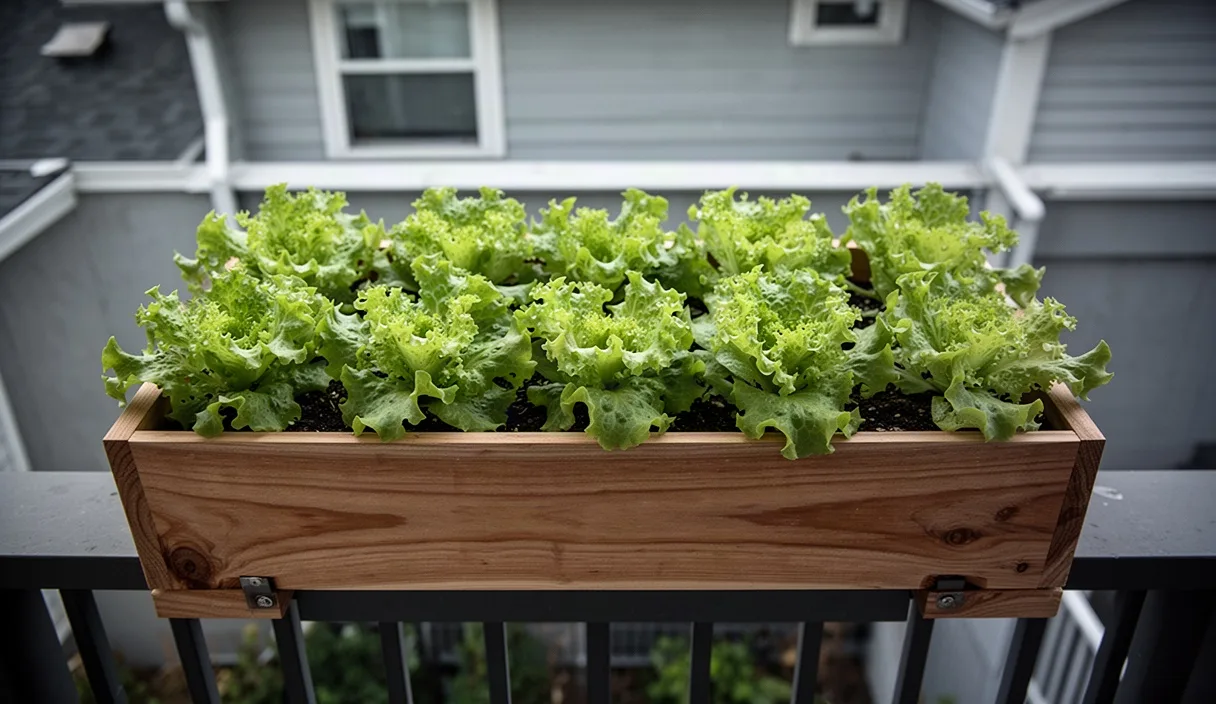

- Select varieties like butterhead lettuce and mizuna that thrive with four hours of indirect light.
- Line wooden planter boxes with breathable landscape fabric to retain soil while draining excess water.
- Harvest outer leaves with clean shears rather than pulling entire root systems.
Urban balconies often lack the six to eight hours of direct sunlight required by fruiting crops such as tomatoes or peppers. High-rise developments, overhanging eaves, and northern orientations limit sunlight to indirect bounce or fleeting morning light. However, leafy greens do not require intense solar radiation to generate vegetative tissue. In fact, high summer temperatures and direct noon sun often trigger premature bolting, bitterness, and leaf scorch in lettuces and brassicas.
A shaded balcony provides a cool, stable microclimate where salad crops can thrive well into late summer. Success depends on building growing boxes tailored to shallow root architectures, selecting crops adapted to low photosynthetically active radiation, and maintaining consistent harvest intervals. With basic tools, untreated timber, and deliberate planning, a shaded urban terrace can produce crisp, dense salad greens from April through November.
Evaluating Available Daylight and Reflective Balcony Surfaces
Before buying seed or cutting wood, track the light entering the balcony space over three consecutive clear days. Shaded spaces generally receive two categories of usable illumination: low direct sunlight (under three hours daily) or bright indirect ambient light. Plants convert ambient light into energy, but they require a minimum threshold. If a space is too dim to read print comfortably at noon without artificial light, greens will grow leggy, pale, and prone to damping-off fungi.
You can quantify balcony light without expensive laboratory gear. Download a calibrated foot-candle or lux meter app for a smartphone, or use a handheld photographic light meter. Take readings at 9:00 AM, 1:00 PM, and 5:00 PM where you intend to mount the boxes. Leafy crops require a minimum of 1,000 to 1,500 foot-candles for at least five hours to generate firm cellular walls. If your readings fall below this baseline, strategic reflection will recover lost energy.
Urban surfaces absorb or bounce light depending on finish and color. Matte white surfaces reflect up to 85 percent of ambient daylight without creating burning focal points. You can increase available photons by outfitting the wall behind the planter with light-colored panels, removable outdoor Mylar film, or a coat of exterior-grade white paint on existing brickwork where tenant agreements permit. Avoid mirrored glass, which creates concentrated hotspots that scorch damp foliage.
| Balcony Wall Surface | Estimated Light Reflection | Impact on Salad Growth |
|---|---|---|
| Standard red brick | 15 to 30 percent | Minimal; greens lean noticeably toward balcony rail |
| Aged dark concrete | 20 to 35 percent | Retains heat overnight; low ambient photon bounce |
| Matte white exterior panel | 75 to 85 percent | Diffuses light evenly; reduces stem elongation |
| Removable garden Mylar | 90 to 95 percent | Maximizes diffuse bounce; prevents asymmetric growth |
Constructing Shallow Wooden Planters with Free Drainage
Salad greens produce fibrous, shallow root systems that rarely extend beyond four to six inches into the substrate. Deep containers waste growing medium, retain excess water in shaded conditions, and add unnecessary structural weight to balcony decking. A planter box built with an internal depth of six inches provides adequate root run while ensuring the soil column dries out predictably between waterings.
Select rot-resistant, untreated timber. Western red cedar, cypress, and black locust offer natural resistance to fungal decay without leaching chemical preservatives into your salad soil. Douglas fir or standard untreated pine provides a lower-cost alternative that lasts two to four seasons if kept off wet deck floors. Avoid pressure-treated wood manufactured before 2004 due to arsenic content; modern alkaline copper quaternary lumber is safer, but untreated heartwood remains the cleanest choice for edible leafy greens.
Assemble the box using exterior-grade, ceramic-coated screws or stainless steel fasteners measuring 2.5 inches in length. Standard drywall screws corrode rapidly under damp organic potting mixes. Space drainage holes every four inches along the bottom board using a half-inch spade bit. Free drainage is non-negotiable on a shaded balcony, where water evaporation is a fraction of that found in open garden plots.
- Cut side panels to 36 inches in length and end panels to 8 inches in width using nominal 1x8 boards.
- Drill pilot holes into the outer faces to prevent the grain from splitting near the board ends.
- Affix bottom planks, leaving a steady 1/8-inch gap between floor slats to supplement drilled drainage holes.
- Line the interior bottom with woven landscape fabric, not plastic sheeting, to contain potting mix while permitting surplus runoff.
- Screw two-inch square wooden cleats or composite decking offcuts to the underside corners to raise the box floor off the balcony deck.
Crop Selection for Shaded and North-Facing Exposures
Not all greens tolerate low-light conditions equally. Heading lettuces, such as crisphead or dense Romaine varieties, demand substantial photosynthetic energy to pack tightly folded leaves and frequently stall in north-facing spaces. Loose-leaf cut-and-come-again varieties, along with mustard greens and brassica cultivars, produce tender yields under indirect light because they invest energy in broad surface foliage rather than dense root crowns or heads.
Asian greens represent the highest-yielding group for shaded balcony boxes. Mizuna, tatsoi, and komatsuna tolerate limited direct sun and maintain rapid cellular division under cool spring and autumn conditions. Their leaves stay tender in shade, avoiding the leathery texture that brassicas sometimes develop under baking sun. Sorrel, corn salad (mache), and chervil also register reliable growth rates in low-light environments.
For standard salad flavor profiles, choose loose-leaf and oakleaf lettuces over tight-heading types. Cultivars such as 'Black-Seeded Simpson', 'Salad Bowl', and 'Red Sails' develop thinner, more tender leaf margins in shade. This thinner cuticle makes the greens melt-in-the-mouth, though it also reduces shelf life once cut, making rapid consumption from balcony to plate ideal.
| Crop Cultivar | Minimum Daily Light | Growth Habit in Shade | Primary Risk |
|---|---|---|---|
| Mizuna (Brassica rapa) | 2.5 hours indirect | Rapid, feathery, uniform spread | Flea beetle damage on seedlings |
| 'Black-Seeded Simpson' | 3 hours indirect | Broad, bright green, loose leaves | Soft leaves tear in strong winds |
| Tatsoi (Brassica narinosa) | 3 hours bright ambient | Spreads flat, spoon-shaped leaves | Slugs attracted to lower leaves |
| Garden Sorrel (Rumex) | 2 hours ambient | Perennial, dense basal clump | Oxalic acid accumulation if dry |
| Corn Salad / Mache | 2 hours ambient | Compact rosettes, cold-tolerant | Very slow initial germination |
Succession Planting Calendars for Continuous Leaf Harvests
Shaded containers do not generate leaf volume as fast as full-sun market gardens. A single sowing of loose-leaf lettuce will provide three to four cuttings before the plant tires or attempts to bolt. To secure an unbroken supply of salad greens from a small surface footprint, you must practice disciplined succession sowing on a 14-day rotational cycle.
Divide your planter space into three equal distinct operational zones or run three separate 36-inch boxes side by side. Plant Zone A on day one, Zone B on day 14, and Zone C on day 28. By the time Zone C germinates, Zone A is ready for its primary cut, and Zone B is closing its canopy. When Zone A finishes its third cut cycle and shows signs of bitterness, pull the roots, incorporate a handful of worm castings, and re-sow the soil.
Seed depth in shaded boxes requires precision. Because soil surfaces dry out slowly in the absence of direct sun, sowing too deep causes seeds to rot before the hypocotyl reaches light. Sow small lettuce and brassica seed no deeper than 1/8 inch, or simply broadcast the seed across moist soil and press it down with a flat board, dusting a paper-thin layer of vermiculite over the top to retain ambient humidity.
- Early Spring (Late March to Mid-April): Sow cold-hardy brassicas, mache, and spinach directly into the boxes as soon as daytime outdoor temperatures average 45 degrees Fahrenheit.
- Late Spring (May): Introduce loose-leaf lettuces, chervil, and arugula into newly cleared rotation zones.
- Midsummer (July to August): Continue shaded sowings of tatsoi and oakleaf lettuces; shaded balconies protect these cool-season crops from the heat spikes that wreck sun-drenched gardens.
- Early Autumn (September): Sow final successions of mizuna, winter purslane (miner's lettuce), and corn salad for harvests extending through November freezes.
Cut-and-Come-Again Harvesting Mechanics
Harvesting leafy crops incorrectly kills the root system or terminates leaf generation prematurely. Salad crops grow from a central growing point known as the apical meristem or crown, located just above the soil surface. Severing this crown ends the plant's life cycle. A correct cut-and-come-again technique preserves the crown while taking only the mature peripheral foliage.
Always use a sharp, sterilized pair of bonsai snips, floral shears, or carbon steel scissors. Tearing leaves by hand pulls on the shallow root system, dislodging fine feeder roots from the potting medium and setting growth back several days. Sanitize your cutting blade with isopropyl alcohol before each harvest session to prevent transferring pathogens between boxes.
Execute your cuts when the outer leaves reach four to five inches in length. Gather the outer ring of leaves in one hand and cut them clean approximately one inch above the soil level. Leave the smaller, immature center leaves intact; they contain the juvenile photosynthetic machinery that powers the next growth flush. Never strip more than 60 percent of a plant's total leaf area in a single harvest, or the root system will stall from sudden carbohydrate starvation.
Harvest during early morning hours while cellular turgor pressure remains at its peak. Leaves gathered at midday or late afternoon, even in shade, have transpired moisture through their stomata and will wilt rapidly on the kitchen counter. Plunge freshly cut greens immediately into a bowl of cold tap water for five minutes, spin them dry in a salad spinner, and store them uncompressed in a ventilated container lined with a dry towel.
Harvesting Schedule Across 60 Days
- Days 1 to 20: Seed emergence and development of the first true leaves; thin crowded seedlings to two inches apart, consuming the thinnings as microgreens.
- Days 21 to 35: Canopy closes; execute initial harvest cut on outer leaves of Zone A; Zone B reaches thinning stage.
- Days 36 to 48: Second cut on Zone A; primary cut on Zone B; Zone C ready for thinning.
- Days 49 to 60: Third cut on Zone A; terminate Zone A roots; secondary cut on Zone B; primary cut on Zone C. Re-sow Zone A.
Pest Management for Containerized Urban Greens
Shaded balcony environments alter pest dynamics. While direct-sun pests like spider mites rarely establish colonies in moist, cool shade, other problems flourish. Poor air circulation combined with high humidity creates hospitable conditions for fungus gnats, terrestrial slugs, and gray mold (Botrytis cinerea). Aphids also find shaded balcony greens attractive because the softer plant cuticle makes piercing sap extraction easier.
Inspect the undersides of leaves weekly with a 10x jeweler's hand lens. At the first sign of green peach aphids or black bean aphids, wash them away using a pressurized brass hand-sprayer filled with clean water. If colonies persist, apply an insecticidal soap diluted to a two percent concentration, coating the foliage thoroughly at dusk. Do not apply horticultural soaps in the morning; even in shade, soaps wet with light air movement can cause leaf edge necrosis.
Slugs reach upper-floor urban balconies via soil bags, potted nursery starts, or building masonry. They operate exclusively at night, devouring young seedlings down to the soil line. Spread a clean, dry layer of coarse horticultural perlite or crushed eggshells around the perimeter of the planter boxes. For active infestations, apply an iron phosphate bait along the soil surface. Iron phosphate halts slug feeding without posing risks to urban songbirds or domestic pets.
Fungus gnats indicate that the upper inch of soil is remaining persistently saturated. Their larvae chew on delicate root hairs, stunting leaf expansion. Allow the top half-inch of the substrate to dry dry to the touch before watering, and apply water directly to the soil surface using a long-spouted can rather than wetting the foliage. You can introduce beneficial nematodes (Steinernema feltiae) into the boxes once in spring to digestive balance gnat larvae throughout the season.
Common Mistakes to Avoid
Overwatering ranks as the most destructive mistake in shaded urban growing. Without the sun to accelerate transpiration, soil stays damp for days. Applying water on a rigid daily schedule starves roots of oxygen, leading to pythium root rot. Always probe the potting mix with your index finger down to the second knuckle; if moisture is detectable, postpone watering.
Using ordinary topsoil or heavy compost mixes from a garden center packs down into an airless brick inside shallow containers. Shaded salad planters require an airy, porous medium consisting of approximately 45 percent peat moss or coconut coir, 35 percent screened perlite or pumice to preserve air spaces, and 20 percent well-rotted worm castings or compost for baseline nutrition.
Overcrowding seeds reduces final yield. When seeds are sown too thickly without subsequent thinning, seedlings compete for the already scarce photons of light. The result is tall, thread-like stems that collapse under their own weight. Thin seedlings aggressively until loose-leaf plants stand three to four inches apart, and larger brassicas stand five inches apart.
Practical Next Steps
To establish your shaded balcony salad system this season, begin with these immediate actions:
- Measure your balcony floor plan, check structural load allowances, and determine the linear footage available along walls or interior railings.
- Procure three 8-foot lengths of 1x8 untreated Western red cedar or local rot-resistant timber, along with stainless steel trim screws.
- Construct two or three 36-inch boxes, outfitting each with 1/2-inch drainage holes and exterior risers to ensure clean drainage.
- Blend your growing mix using coir, perlite, and worm castings, filling boxes to within one inch of the top rim.
- Acquire seed packets of shade-tolerant cultivars: at minimum, one loose-leaf lettuce, one mizuna variety, and one batch of tatsoi.
- Sow your first rotational box, record the date in a logbook, and schedule the second sowing for exactly two weeks later.
This guide serves educational purposes; consult your regional agricultural extension office for site-specific soil testing and plant health orders. Disclaimer