You will assemble an airy potting blend and provide stable staking within a compact five-gallon container footprint. Maintain consistent moisture levels to eliminate blossom end rot in warm urban conditions.

- Combine peat moss, coarse perlite, and screened compost in equal volumes for container drainage.
- Anchor a heavy central bamboo cane into the bottom base before planting root balls.
- Water until slight runoff occurs every morning to avoid dry pockets within the root zone.
Balcony tomato cultivation presents distinct physical limits that standard garden advice ignores. Suspended several floors above ground, plants encounter high wind velocities, intense reflected heat from masonry, and an absolute boundary on root spread. Traditional indeterminate vines quickly outgrow these spaces, collapsing under their own weight or desiccating when container soil runs dry mid-afternoon. True dwarf varieties alter this equation by pairing the fruit quality of full-sized heirlooms with a rigid, compact vascular architecture that tops out between two and four feet.
Succeeding in a five-gallon container requires managing the microclimate rather than fighting it. A five-gallon root volume provides roughly 0.67 cubic feet of substrate, which holds enough water and nutrients to carry a heavy-bearing plant through a scorching afternoon if the media retains physical structure. By choosing cultivars bred specifically for compact verticality, mixing soil that balances porosity against water retention, and matching irrigation to the thermal behavior of concrete slabs, you can pull significant harvests from a small urban footprint.
Selecting True Dwarf Determinate Cultivars
Do not confuse micro-dwarf tomatoes with true dwarf varieties. Micro-dwarfs such as Tiny Tim or Red Robin rarely exceed twelve inches in height and produce small cherry fruit with thin flavor profiles. True dwarf varieties, largely developed through the collaborative Dwarf Tomato Project, result from crosses between standard heirloom vines and compact dwarf selections. They feature thick, central stems, dark green rugose (crinkled) foliage, and internode spacing that is a fraction of standard varieties. Crucially, they yield medium to large slicers, paste tomatoes, and oxhearts on plants that stay between thirty and forty-eight inches tall.
When selecting seed or starts, distinguish between dwarf determinate and dwarf indeterminate types. Dwarf determinates set their flowers over a concentrated three-to-four-week window, ripen the bulk of their fruit simultaneously, and then cease production. This habit suits growers who want an early harvest or plan to preserve sauce. Dwarf indeterminates continue to grow vegetatively while flowering and setting fruit across the entire season until frost halts them. Both growth habits perform reliably in five-gallon containers, but your choice dictates how you space and feed the crop.
| Cultivar | Growth Habit | Fruit Size and Type | Days to Maturity |
|---|---|---|---|
| Dwarf Arctic Rose | Determinate | 3-8 oz, pink slicer | 60-65 |
| Adelaide Festival | Indeterminate Dwarf | 6-10 oz, purple-green stripe | 75-80 |
| Rosella Crimson | Indeterminate Dwarf | 6-12 oz, deep pink beefsteak | 70-75 |
| Tasmanian Chocolate | Indeterminate Dwarf | 5-10 oz, brownish-crimson | 70-75 |
Examine the stem structure of seedlings before transplanting. A healthy dwarf seedling shows a stout main stalk, often twice the diameter of a standard seedling at the same developmental stage, with dense leaves clustered close to the soil line. If a nursery seedling appears spindly, pale, or stretched, it lacked sufficient light during early growth. Avoid these specimens, as dwarf plants do not recover from early leggy stretching as quickly as vigorous indeterminate cultivars.
Formulating Soil Mixes for Drainage and Retention
Standard topsoil or garden soil fails completely inside a five-gallon container. Fine field silt compacts under frequent irrigation, drives out oxygen, and forms a dense mud layer at the base of the pot. Balcony containers demand a soilless media with high macro-porosity that drains freely while holding plant-available water within micro-pores. The mix must resist rapid decomposition across the four to six months of active growth.
A proven base mix for warm-climate balcony containers utilizes a three-part framework by volume:
- Sphagnum peat moss or washed coconut coir (40%): Provides the base moisture retention and cation exchange capacity. Coir wets more easily than dry peat, but quality varies; rinse coir before use to flush out residual sodium salts.
- Coarse perlite or pumice (30%): Creates stable aeration channels that will not collapse under root pressure or frequent saturation. Use medium-to-coarse grade perlite rather than fine nursery dust.
- Composted pine bark fines (30%): Adds long-term structure, resists compaction, and encourages beneficial fungal colonization. Particles should range from one-eighth to three-eighths of an inch.
To this base volume, blend in five to seven ounces of coarse agricultural vermiculite to soften dry-down spikes, along with two tablespoons of pulverized dolomitic limestone per five gallons of mix if using peat. Peat carries an acidic pH of 3.8 to 4.5, which locks out essential nutrients; the limestone raises the pH to an optimal 6.2 to 6.6 range while providing foundational calcium and magnesium. Moisten the entire dry volume thoroughly 24 hours before potting up. If you squeeze a handful of media, it should hold together in a loose clump without water dripping between your fingers.
Container Volume and Fabric Aeration Benefits
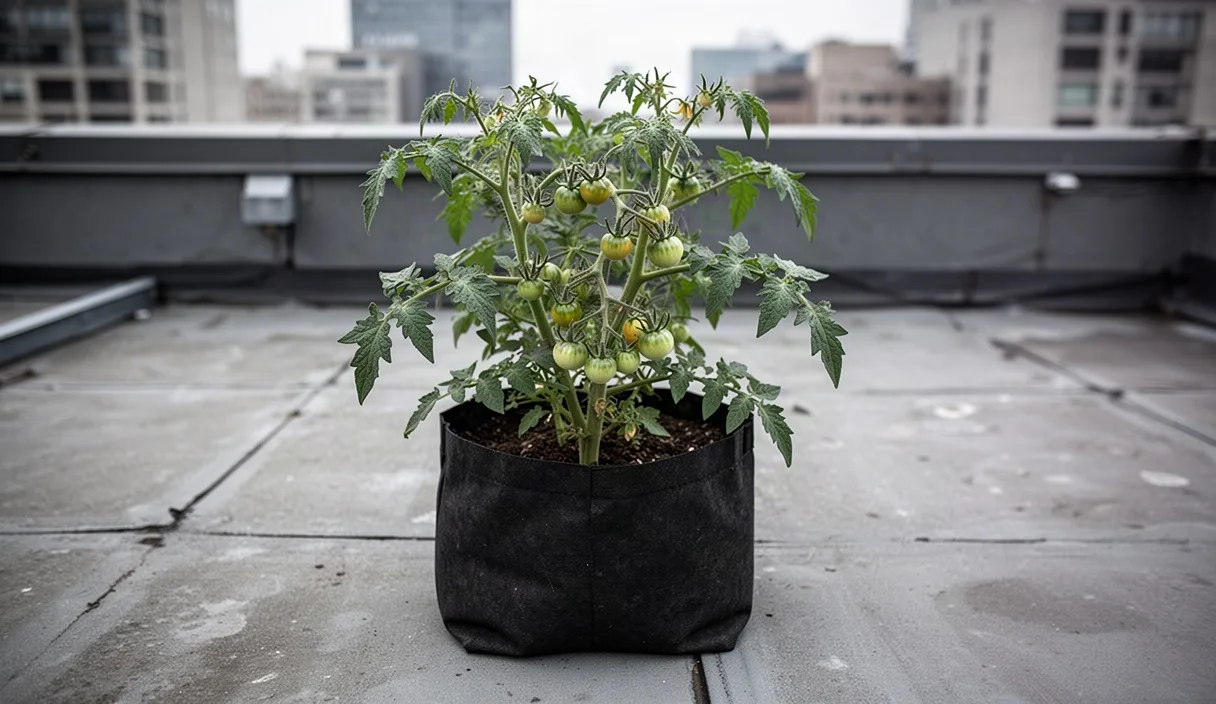
A five-gallon volume represents the minimum threshold for growing true dwarf varieties to full productivity. In smaller containers, root temperatures fluctuate violently, and available water depletes within hours on windy days. While rigid plastic nursery pots are inexpensive and durable, fabric grow bags constructed from heavy needle-punched polypropylene (around 300 to 400 grams per square meter) offer marked advantages on a balcony.
Plastic containers force roots to circle the interior walls once they strike the slick surface. This circular growth creates a dense root mat at the container periphery, vulnerable to radiant heat, while leaving the core volume underutilized. Fabric containers naturally air-prune the roots. When root tips hit the porous fabric wall, exposure to air dehydrates the apical root tip, triggering branching deeper within the potting mix. This process generates a dense, fibrous root mass distributed evenly through the substrate, maximizing nutrient interception.
Fabric pots also moderate root-zone temperature through evaporative cooling across their exterior surfaces. While this characteristic increases overall daily water demand, it lowers root-zone temperatures by four to eight degrees compared to dark plastic pots exposed to direct sunlight. When winds pick up, fabric containers offer a broad, stable footprint that prevents tall, top-heavy dwarf plants from toppling. Insert a short, rigid stake or heavy gauge tomato cage directly into the bag at planting time to anchor the central stem against balcony gusts.
Daily Moisture Rhythms on Warm Concrete Balconies
Balconies act as thermal heat sinks. Concrete slabs and brick facades absorb solar radiation throughout the midday hours and re-radiate thermal energy long into the evening. Combined with wind turbulence around building corners, this elevated heat load creates a high vapor-pressure deficit, pulling moisture from container foliage and soil faster than in ground-level beds.
Watering schedules must adjust to this thermal reality. Apply water early in the morning, before direct sun strikes the foliage and floor slab. Morning hydration ensures the vascular system is pressurized with water before peak ambient temperatures arrive. Check containers again in mid-afternoon. If the top two inches of media feel dry and the container feels light when tilted slightly, apply a second, lighter volume of water to bridge the plant through sunset. Avoid late-night watering that leaves foliage and soil surfaces wet in low-light conditions, which fosters foliar fungal pathogens.
- Inspect the soil core: Insert a thin wooden skewer into the root ball down to four inches. If it comes out clean and dry, moisture is low; if it shows damp particles clinging along the shaft, the internal core remains hydrated.
- Apply water slowly around the drip line: Pour water across the surface until moisture begins to seep evenly from the bottom seams of the fabric bag. Rushing water onto dry media causes it to run down the interior edges of the pot, bypassing the root core entirely.
- Clear drainage saucers: Never let fabric or plastic containers sit permanently in standing drainage runoff. Reabsorbed runoff introduces concentrated fertilizer salts back into the root zone and drowns deep feeder roots. Elevate pots on plastic risers or pot feet set inside the saucers.
Calcium Availability and Blossom End Rot Prevention
Blossom end rot appears as a flat, leathery, dark patch at the distal end of the tomato fruit. This condition is a physiological disorder caused by local calcium deficiency within the rapidly expanding fruit cells. While soil mixes rarely lack calcium if amended with limestone or gypsum, the delivery mechanism often breaks down on balconies due to erratic transpiration.
Plants transport calcium exclusively through the xylem via the transpiration stream, moving upward with the flow of water pulled toward the leaves. Calcium does not redistribute via the phloem. If a dwarf tomato wilts during a hot afternoon wind event, the plant closes its stomata to conserve water, instantly halting calcium delivery to the fruit tips. When moisture returns, the fruit resumes rapid cellular expansion without the structural calcium required to build cell walls, resulting in tissue collapse.
Preventing blossom end rot requires stable moisture maintenance rather than pouring random calcium supplements into the soil. Adding eggshells or topical foliar sprays will not solve the issue; foliar-applied calcium cannot move through the leaf surface into the vascular system of the fruit in meaningful quantities. Maintain continuous, even moisture using the soil mix described above. If your irrigation water is exceptionally soft (low dissolved minerals), blend one tablespoon of agricultural gypsum (calcium sulfate) into the soil mix at planting. Gypsum supplies readily soluble calcium without altering the media pH.
Seasonal Feeding with Complete Liquid Nutrients
A five-gallon pot holds a closed, finite reservoir of nutrients that depletes rapidly under the demands of a high-yielding dwarf plant. Controlled-release granular fertilizers provide an initial baseline, but they release nutrients unpredictably in warm weather, often dumping high nitrogen loads early and exhausting their supply just as fruit begins to swell. A managed liquid feeding program gives you precise control over vegetative growth and fruit set.
Use a balanced, completely water-soluble fertilizer containing chelated micronutrients, including iron, manganese, zinc, boron, and molybdenum. During the first four weeks after transplanting, the plant requires an NPK ratio near 3-1-2 or 1-1-1 to build sturdy stems and leafy canopies. As soon as flower clusters open, transition to a low-nitrogen, high-potassium formulation such as 1-2-3 or 2-1-4. Potassium directly drives flower initiation, sugar transport, and fruit sizing.
| Growth Period | Target Ratio (N-P-K) | Dilution Frequency | Electrical Conductivity (EC) |
|---|---|---|---|
| Vegetative Establishment | 15-5-10 or similar | Once weekly | 1.2 - 1.4 mS/cm |
| Flowering and Early Fruit | 10-15-20 or similar | Twice weekly at half-strength | 1.5 - 1.8 mS/cm |
| Peak Fruit Sizing and Ripening | 5-12-26 or similar | Twice weekly at half-strength | 1.8 - 2.1 mS/cm |
Fertilizer salts accumulate rapidly in porous media as water evaporates from the sides of fabric containers. Once every four weeks, flush the entire container volume thoroughly with plain, unfertilized water until at least 20% of the volume applied runs out the bottom. This clears residual sodium and sulfate salts that inhibit water uptake and scorch leaf margins.
Common Mistakes to Avoid
Balcony environments magnify small cultural errors. Avoid these widespread missteps:
- Resting fabric containers directly on bare concrete: Hot floor slabs heat the lower third of the root system to temperatures exceeding 105 degrees Fahrenheit, cooking root hairs and halting water uptake. Place pots on cedar slats, composite decking strips, or commercial pot elevators.
- Over-pruning dwarf canopies: Indeterminate field vines benefit from sucker removal, but dwarf varieties must not be pruned heavily. Pruning dwarfs removes primary fruiting sites and exposes sensitive fruit to direct sunscald. Only strip foliage that directly touches the soil surface.
- Relying on surface inspection: The top half-inch of container media can dry completely in two hours of wind while the root zone stays saturated. Always push a finger or probe three inches into the mix before adding water.
- Using unbuffered garden compost: Raw or heavy backyard compost contains uneven particulate sizes, introducing weed seeds, fungus gnat larvae, and poor drainage properties into the five-gallon space. Use only aged, commercially screened bark and certified clean inputs.
Moving from Planning to Harvest
Begin by securing seeds of established dwarf varieties from dedicated sources rather than settling for generic big-box store seedlings. Start seeds indoors six to eight weeks before your last spring frost date under bright, close-proximity lighting to keep the stems stout and nodes tight.
Prepare your potting mix and containers two weeks before transplanting. Pre-wet the media thoroughly so the lime and organic fractions stabilize. Once night temperatures on your balcony consistently hold above 50 degrees Fahrenheit, harden off the young plants over seven days by gradually exposing them to balcony winds and direct sun. Plant the root ball deep, burying the lower stem up to the first set of true leaves; the buried stem will send out adventitious roots, strengthening your anchor against high-rise gusts. Install a stout bamboo cane or steel cage into the pot on day one, anchor the container off the hot concrete floor, and maintain consistent moisture to ensure steady development straight through to harvest.
This guide serves educational purposes; consult your regional agricultural extension office for site-specific soil testing and plant health orders. Disclaimer