You will diagnose the exact ratio of light intensity to heat that causes weak stem elongation. Adjust fixture height and ambient room temperature to produce stocky, resilient transplants.
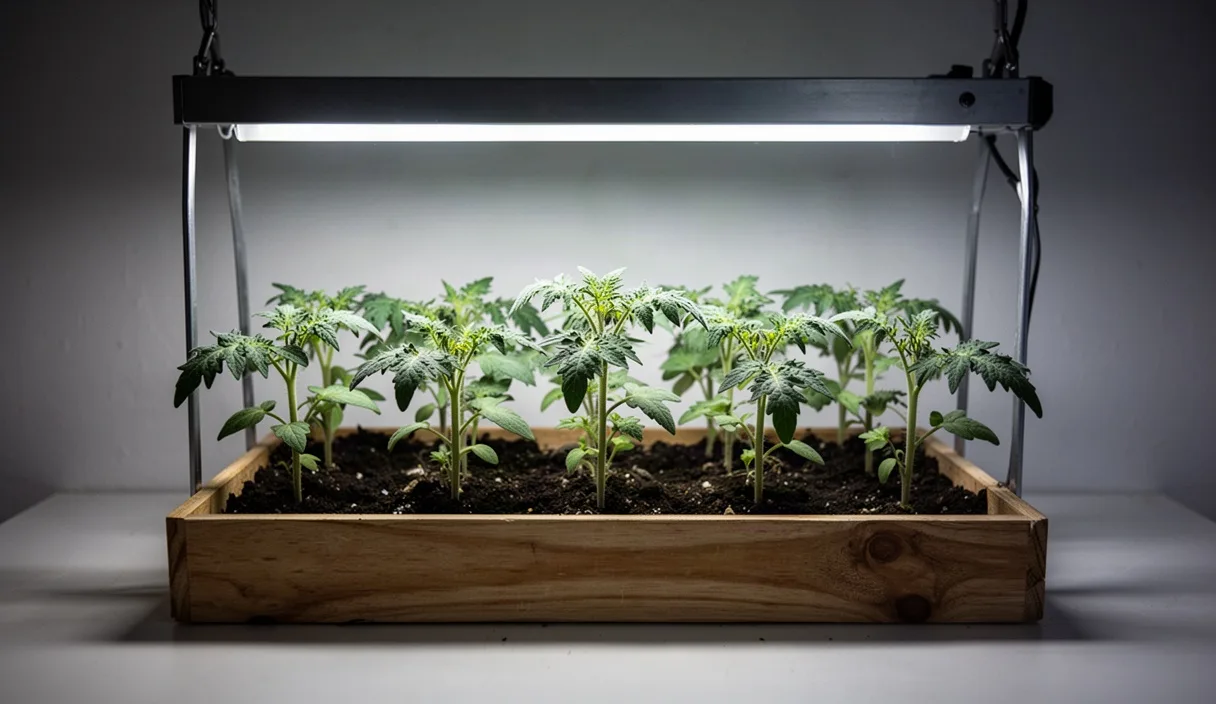

- Position standard LED shop lights within five centimeters of emerging canopy leaves.
- Drop ambient night temperatures by four degrees Celsius to slow excessive stem growth.
- Run an oscillating fan on low speed for two hours daily to stimulate lignin production.
Indoor seed starting collapses most often at the hypocotyl, the fragile region of stem between the root crown and the cotyledons. When a seedling receives insufficient photon flux relative to the ambient heat of its growing space, it triggers etiolation. Cells along the stem elongate rapidly as the plant allocates all stored seed energy upward in search of an unobstructed canopy. The result is a pale, weak stem that cannot support the weight of subsequent foliage, invites damping-off pathogens, and permanently impairs the plant vascular architecture before root systems establish.
Modern solid-state lighting can eliminate stem stretch, but high-efficiency LEDs introduce unique operational variables. Unlike fluorescent tubes or high-pressure sodium fixtures, quality white-spectrum LEDs emit high Photosynthetic Photon Flux Density (PPFD) with negligible radiant heat. Growers who place LEDs at traditional fluorescent distances risk photobleaching, while those who pull them too far away generate thin, fallen stems within 72 hours of germination. Managing stem girth requires coordinating photon quantity, daily light integral, thermal tracking, and physical airflow.
Light Intensity Requirements for Solanaceous Crops
Solanaceous crops including indeterminate tomatoes, sweet peppers, and eggplants demand significant photon density from the hour of emergence. Cotyledons contain limited cotyledonary reserves. Once emergence occurs, the plant must immediately switch from metabolic reliance on endosperm to autotrophic carbon fixation. If the photosynthetic engine does not receive the photon density necessary to sustain active respiration, stem elongation runs unchecked.
Growers must measure light using PPFD, recorded in micromoles per square meter per second (µmol/m²/s), rather than foot-candles or lux. Lux meters calculate sensitivity based on human eye perception, which peaks in the green spectrum, whereas seedling photoreceptors (specifically cryptochromes and phytochrome B) respond directly to blue and red photons to inhibit stem extension. Full-spectrum white fixtures containing diodes with a high 450-nanometer blue spike are most effective at suppressing early hypocotyl stretch.
| Crop Type | Emergence PPFD (µmol/m²/s) | First True Leaf PPFD (µmol/m²/s) | Target Photoperiod (Hours) | Target Daily Light Integral (mol/m²/day) |
|---|---|---|---|---|
| Tomatoes (Solanum lycopersicum) | 150 to 200 | 250 to 350 | 16 | 14.4 to 20.1 |
| Peppers (Capsicum annuum / chinense) | 120 to 160 | 200 to 280 | 14 to 16 | 10.1 to 16.1 |
| Eggplants (Solanum melongena) | 140 to 180 | 220 to 300 | 14 to 16 | 11.1 to 17.3 |
To reach these targets without expensive commercial quantum sensors, review the manufacturer PAR map for your fixture. A typical 100-watt true-draw LED panel should sit between 12 and 18 inches above the tray surface during the first week. If you use low-output LED shop lights drawing only 20 to 30 watts per four-foot strip, drop the housing to 3 to 5 inches above the canopy. Check light falloff at the perimeter of the tray. Seedlings located on the outer edge of a 1020 tray often stretch toward the center, indicating that PPFD drops below 100 µmol/m²/s on the margins. Rotate trays 180 degrees every 24 hours to balance light distribution if edge falloff exceeds 30 percent.
Balancing Ambient Temperature with Photon Delivery
Light intensity does not dictate stem growth in isolation. Temperature governs the rate of plant metabolism, cell division, and chemical reactions, while light provides the energy to build physical cell walls. When seedlings experience high root-zone and ambient temperatures combined with moderate or low light, enzymatic activity outpaces sugar production. The plant builds large, thin-walled, water-filled cells that stretch rapidly, producing weak structural tissue.
Germination mats often cause problems at this stage. Bottom heat mats are critical for breaking seed dormancy in peppers and eggplants, which prefer a media temperature between 80 and 85 degrees Fahrenheit. However, the moment radical emergence and hooked stems appear above the media surface, you must disconnect the heat mat or transfer the tray to an unheated shelf. Leaving sprouted seedlings on an active heat mat at 82 degrees Fahrenheit under standard indoor lights forces severe hypocotyl extension within 36 hours.
Maintain precise control over the differential between day and night temperatures, known in horticultural production as DIF (Day temperature minus Night temperature):
- Negative DIF: Setting the day temperature cooler than the night temperature suppresses stem elongation. A day temperature of 65 degrees Fahrenheit and a night temperature of 68 degrees Fahrenheit keeps seedlings compact without reducing overall root development.
- Zero DIF: Equal day and night temperatures (for example, 68 degrees Fahrenheit day and night) produce predictable, stocky vegetative growth suitable for most home nurseries.
- Positive DIF: Setting the day temperature significantly higher than the night temperature (such as 78 degrees Fahrenheit day and 62 degrees Fahrenheit night) triggers rapid internodal stretch, particularly when light levels fail to match the higher daytime metabolic rate.
For solanaceous species, target an ambient daytime temperature of 65 to 70 degrees Fahrenheit once cotyledons expand. Drop the night temperature to 60 to 65 degrees Fahrenheit. This range slows unnecessary cellular expansion, hardens early tissue, and allows carbohydrate reserves generated during the lit photoperiod to accumulate rather than burn off through night respiration.
Air Movement as a Mechanical Growth Regulator
Plants respond structurally to physical forces. In natural settings, continuous variations in outdoor air velocity bend young stems, creating mechanical stress. The plant senses this movement through cell membrane mechanosensors and initiates a physiological adaptation known as thigmomorphogenesis. This response slows vertical stem elongation, increases stem caliper, and stimulates production of structural lignin within the vascular bundles.
Seedlings started inside sealed rooms, basements, or enclosed propagation tents encounter no natural wind resistance. Without mechanical stimulation, plants produce taller, narrower stems even under adequate light. Stagnant air also creates a deep, humid boundary layer around the foliage. This boundary layer suppresses transpiration, prevents the root system from drawing calcium efficiently up the vascular column, and weakens the cell walls of the expanding hypocotyl.
Integrate mechanical stimulation into your indoor setup through deliberate air management:
- Position an oscillating fan 3 to 6 feet away from the seedling bench. Do not aim a direct, stationary air stream at a single flat of seedlings, which desiccates fragile cotyledons and creates uneven drying in cell packs.
- Adjust the fan speed until the seedling stems vibrate gently. If the stems bend past a 30-degree angle from the vertical, reduce velocity or increase the distance of the fan from the tray.
- Run the oscillating fan on an intermittent timer, providing air movement for 15 minutes out of every hour during the lights-on cycle. Continuous high-velocity air movement can induce stomatal closure and reduce daily photosynthetic gains.
- Implement manual brushing if space limits fan placement. Stroke a clean sheet of cardstock or a bare hand lightly across the canopy tops for 20 passes twice daily. Research confirms that deliberate mechanical brushing reduces seedling height by 20 to 35 percent while increasing stem thickness across tomato and pepper cultivars.
Correcting Stems That Have Already Stretched
If germination issues, power failures, or poor light positioning have produced weak, toppled seedlings, you must assess whether the tissue can recover. Stems that have fallen flat, display brown constriction near the soil line (damping-off caused by Pythium or Rhizoctonia fungi), or have snapped vascular strands cannot be salvaged. If the stem tissue remains firm and green, structural corrections can stabilize the crop.
Recovery approaches differ sharply across botanical families. Tomatoes possess the capacity to generate adventitious roots anywhere along their stems when covered by moist substrate. Peppers and eggplants have much less capacity to produce adventitious roots once stem tissue transitions from juvenile status, requiring alternative handling.
Deep Potting Solanaceous Seedlings
For elongated tomatoes, transplant the seedling into a larger, deeper container (such as a 3.5-inch or 4-inch square nursery pot) as soon as the first set of true leaves begins to form:
- Moisten the growing medium in the original tray thoroughly 30 minutes before handling to preserve root hair integrity.
- Fill the new container one-third full with a pre-moistened, well-draining peat-perlite or coco-perlite potting blend.
- Gently lift the seedling by its cotyledon leaves, never by the fragile stem. Crushing the hypocotyl damages the xylem and phloem vessels permanently.
- Lower the seedling into the pot so that the root ball rests near the bottom and the stem stands vertically.
- Fill around the stem with potting mix, burying the hypocotyl up to roughly a quarter-inch below the cotyledons. Firm the mix gently to eliminate air pockets, then water thoroughly with room-temperature water. Adventitious roots will develop along the buried stem segment within 7 to 10 days, converting the weak hypocotyl into a wider anchoring system.
Stabilizing Non-Rooting Species
Burying the stems of sweet peppers, hot peppers, and eggplants up to the cotyledons often leads to collar rot if the potting mix remains wet. For these species, bury the stem only up to half its exposed height, ensuring the media drains rapidly. If the stem still bends under the weight of the cotyledons, construct a split-collar support:
- Cut a 2-inch section of a standard plastic drinking straw.
- Slit the straw lengthwise down one side using a utility knife.
- Gently slip the slit straw around the base of the bent stem and press the bottom half-inch of the straw into the potting mix. This provides structural upright support until secondary cell wall thickening occurs. Remove the collar once the stem caliper doubles.
Transition Timing for First True Leaf Development
The appearance of the first true leaves marks the complete depletion of seed-stored reserves and signals a shift in environmental requirements. The plant is now an established vegetative unit capable of utilizing higher light intensities and balanced mineral nutrition. Leaving seedlings under weak light during this transition guarantees stretched internodes between the cotyledon node and the primary true leaf node.
Adjust environmental controls systematically as the first true leaves expand to the width of the initial cotyledons:
- Increase Photon Delivery: Step up the PPFD output. Lower your LED fixture by 2 to 4 inches or turn up your digital dimmer by 20 to 25 percent. Increase the target PPFD to 250 to 350 µmol/m²/s for tomatoes and 200 to 280 µmol/m²/s for peppers. Watch the upper foliage closely for 48 hours. If leaf margins cup upward or bleach to an off-white hue, raise the fixture two inches to relieve photo-oxidative stress.
- Implement Mild Nutritional Feeding: Seed starting media typically contains negligible baseline nutrition. When true leaves appear, apply a balanced water-soluble fertilizer containing nitrate nitrogen, phosphorus, potassium, and micronutrients at an electrical conductivity (EC) of 0.8 to 1.2 mS/cm (or approximately 50 to 75 parts per million nitrogen). Avoid heavy applications of ammonium-based nitrogen, which drives rapid, soft vegetative stretch. Nitrate-dominant formulas foster tighter internodes and thicker leaf tissue.
- Calibrate Photoperiod: Set your light timers to run consistently for 14 to 16 hours daily. Providing 24 hours of continuous light under strong LEDs does not accelerate growth proportionally and can induce chlorosis and leaf deformities in certain tomato cultivars. A dark period of 8 to 10 hours is critical for physiological translocation of starches and normal cell division cycles.
- Monitor Moisture Cycles: Stop keeping the medium continuously saturated. Allow the surface of the potting mix to dry from dark brown to a lighter color before bottom-watering. Mild, controlled dry-down cycles restrict cell enlargement naturally, resulting in shorter, resilient stems.
Common Mistakes
- Relying on Window Light: Placing seedling trays on south-facing windowsills results in severe phototropism. Winter and early spring sunlight angles provide weak, short-duration DLI, forcing stems to stretch rapidly toward the glass at an acute angle.
- Leaving Clear Humidity Domes in Place: Humidity domes are germination aids designed to preserve media moisture until emergence. Leaving them over growing seedlings traps excess heat, builds relative humidity to near saturation, blocks 10 to 15 percent of light output, and rapidly induces fungal damping-off and etiolation. Remove domes the moment the first green hooks emerge.
- Misjudging Human Eye Brightness for Plant Energy: Modern domestic LEDs appear bright to human vision without emitting sufficient PAR photons. Using standard non-horticultural LED bulbs or unrated decorative strips rarely yields the minimum 150 µmol/m²/s needed to keep solanaceous seedlings stocky.
- Over-Fertilizing with High Nitrogen: Feeding stressed, etiolated seedlings with concentrated synthetic nitrogen accelerates vertical growth before the vascular system can support it. Never exceed an EC of 1.2 mS/cm during the first two weeks of active vegetative growth.
- Neglecting Light Spread: Concentrating four 1020 trays under a single small LED fixture guarantees that outer plants stretch toward the center. Match the light coverage footprint to the actual dimensions of the seedling trays.
Practical Next Steps
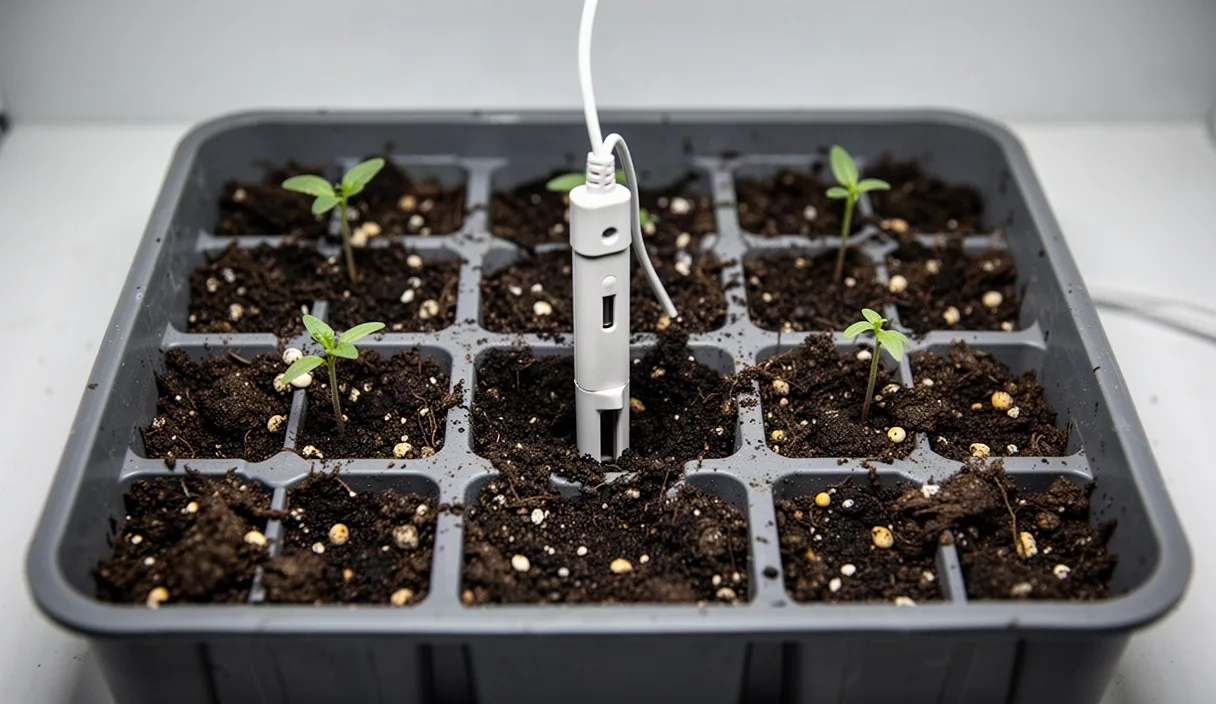
Begin by auditing your current seedling environment with accurate measuring tools. Obtain an inexpensive digital thermometer-hygrometer to record daytime highs and nighttime lows directly at the canopy level. If your budget does not allow for a commercial quantum PAR meter, download a calibrated light measurement smartphone app verified against horticultural sensors to obtain an approximate PPFD reading across the perimeter and center of your flats.
Inspect your active seed trays twice daily during germination. Turn off bottom heat mats the hour cotyledons emerge from the soil. Position your LED fixtures at the heights specified for your fixture wattage, turn on an oscillating fan to provide gentle stem vibration, and verify that day temperatures remain at or below 70 degrees Fahrenheit. If specific varieties display early stretching, lower your light fixtures, check ambient temperatures, and pot up tomatoes deeply into clean, moist potting substrate before root binding occurs.
This guide serves educational purposes; consult your regional agricultural extension office for site-specific soil testing and plant health orders. Disclaimer